
The Austin Budget Explained: General Fund vs Enterprise Funds vs Bonds
Why “the City spent $X” is often not one pot of money, and how bond elections shape big projects.

Hi Friends & Neighbors,
Thank you to everyone who came out yesterday evening. It meant a lot to see so many of you and to connect in person.
This is my second post of the week, but I wanted to follow up quickly because new information came out on Monday on the City Council message board that I wanted to address. It adds important context to the ongoing budget and bond conversation, and it’s worth walking through.
If you’ve been following the news lately, you’ve probably seen big numbers tied to the City of Austin: Hundreds of millions. Sometimes billions.
And the natural reaction is simple:
Where is all this money going, and why does it still feel like basic services are stretched thin?
That reaction is valid. But the answer is more complicated than most headlines suggest.
Because when people talk about “the Austin budget,” they are usually combining three very different funding sources and treating them as one pool of money. That misunderstanding is shaping the conversation right now, especially as Council begins discussing a potential 2026 bond election.
So let’s walk through what is actually happening.
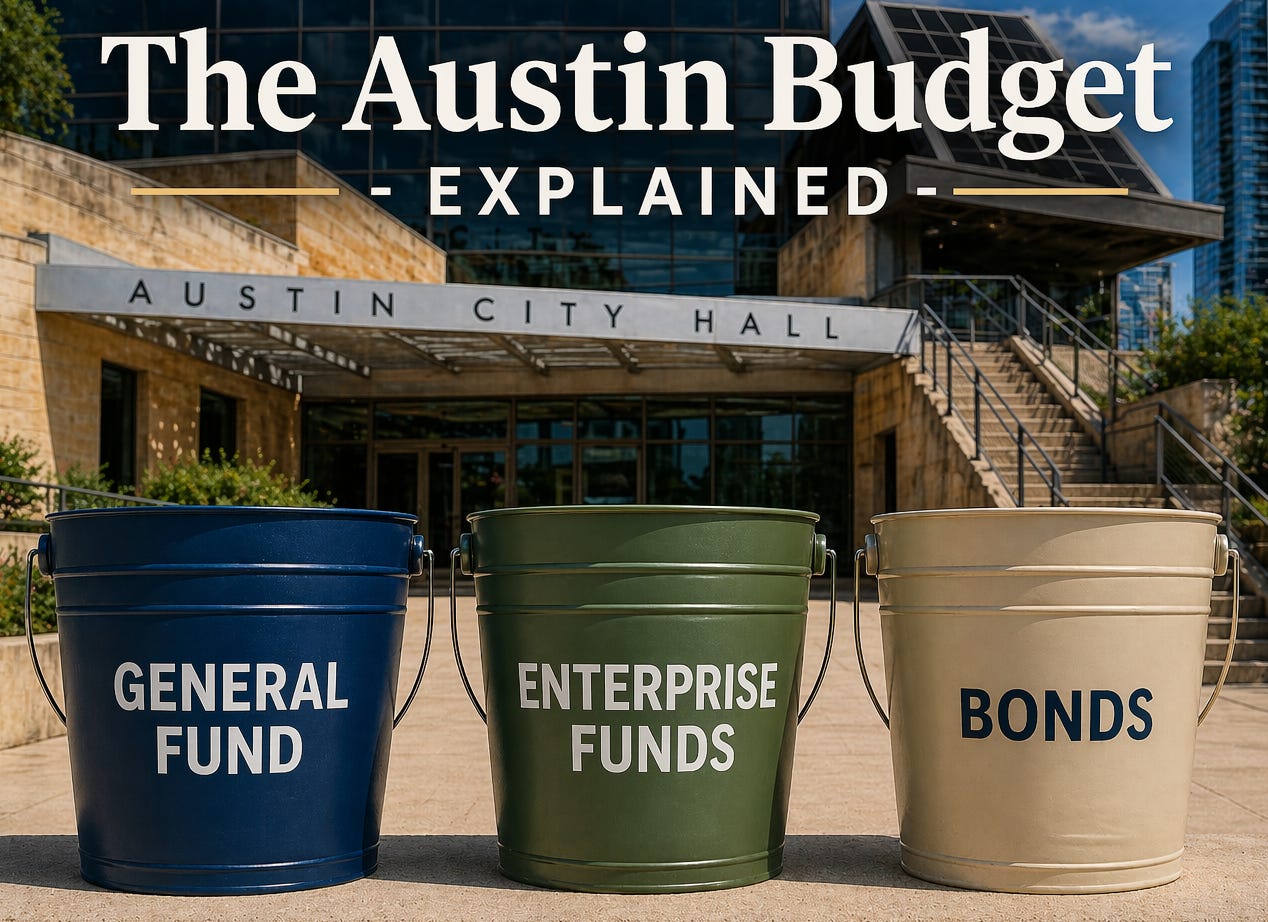
The Three Buckets That Make Up the Budget
If you take nothing else away from this, understand this:
Austin does not have one pot of money. It has multiple systems that operate under different rules.
The General Fund
This is the City’s core operating budget.
It is primarily funded by property taxes and some sales tax revenue, and it pays for the services residents rely on every day:
Police
Fire
EMS
Parks maintenance
Libraries
Code enforcement and basic operations
This is where the Council makes real policy decisions.
If you want to understand priorities, look here. If something feels underfunded or overfunded, this is the bucket that reflects those choices.
This is also the only part of the budget that can be adjusted year to year in a meaningful way.
Enterprise Funds
These are separate, self-funded systems that operate more like utilities or business units.
They include:
Austin Energy
Austin Water
Austin-Bergstrom International Airport
Resource Recovery
They are funded through fees, not property taxes. Your electric bill, your water bill, and airport revenue.
And they are restricted.
The City cannot take money from Austin Energy and use it to hire police officers. Those funds are legally tied to the system that generates them and must cover infrastructure, operations, and debt.
This is where much of the confusion comes from.
A large portion of what is reported as “City spending” resides in Enterprise Funds, even though it cannot be used to address the issues people are often concerned about.
Bonds
Now we get to the part that is currently driving the conversation.
Bonds are how the City pays for large capital projects.
Things like:
New or improved parks
Library buildings and cultural facilities
Roads and mobility infrastructure
Public safety buildings
But bonds are not savings. Bonds are borrowed money.
When voters approve a bond, they are authorizing the City to take on debt and repay it over time, usually through property taxes.
That funding is restricted to the specific projects listed in the bond package. It cannot be used for salaries, staffing, or operations.
What Is Being Discussed Right Now
Earlier this week, Council Member Ryan Alter shared a proposal outlining a supplemental bond scenario that Council may consider as part of a 2026 bond election.
After months of work by staff and the Bond Election Advisory Task Force, this alternate scenario includes:
$250 million to $260 million for parks projects
$50 million to $60 million for community facilities such as libraries and cultural arts
$75 million to $80 million for active transportation projects
The proposal suggests this approach could keep costs to taxpayers under approximately $5 per month while addressing what are described as critical infrastructure needs.
It also signals that additional bond conversations could be deferred to a future election, potentially in 2028.
This is a serious proposal that reflects real needs across the city, but it is important to understand what it does and what it does not do.
What a Bond Election Actually Solves
A bond package like this focuses on physical infrastructure.
It can build things. It can improve things. It can expand capacity in specific areas.
It cannot fix operational gaps.
It cannot:
Increase staffing for police, fire, or EMS
Improve response times on its own
Expand ongoing services
Address day-to-day service delivery challenges
Those issues live in the General Fund.
So when residents say they want better public safety, faster emergency response, or more consistent basic services, a bond election is not the tool that directly addresses those concerns.
That does not make bonds unnecessary. It just means they are often misunderstood.
The Long-Term Tradeoffs
Even when a proposal is framed as costing “less than $5 per month,” it is still a long-term financial commitment.
Every bond adds to the City’s debt load.
That affects:
Future tax capacity
Flexibility in later budgets
The City’s ability to respond to economic changes
And while bonds are restricted in how they can be spent, the repayment is not abstract. It shows up over time in the overall property tax burden.
That is why these decisions matter.
Why This Conversation Feels Off
Right now, the public conversation is mixing together:
Operational frustrations
Infrastructure needs
Total budget numbers
Without clearly separating them.
That leads to confusion.
It leads people to believe that because the City is “spending more,” it should automatically solve every problem.
But the reality is that different dollars are solving different types of problems, and some cannot be moved at all.
What You Should Be Asking
As this process moves forward, here are the questions that actually matter:
Are these the right capital projects for the city right now?
How were these priorities selected, and who had input?
What projects are not being included, and why?
What is the long-term cost to taxpayers beyond the monthly estimate?
And separately, how is the General Fund being prioritized to address core services?
Those are the questions that lead to better outcomes.
What You Can Do
If you care about how this plays out, now is the time to engage.
Bond packages are shaped well before they ever appear on a ballot.
You can email your City Council Member and ask:
What projects do they support and why?
How are they weighing costs against long-term needs?
Whether they believe this proposal reflects what residents are actually experiencing in their district.
You can also submit feedback during the public process as the Bond Election Advisory Task Force finalizes its recommendations.
This is one of the few times residents have a direct opportunity to influence large-scale spending decisions before they are locked in.
Final Thought
Austin’s budget is complex, but it is not unknowable. The key is understanding that not all dollars are created equal.
The General Fund determines how the City operates day to day.
Enterprise Funds keep major systems running.
Bonds shape the physical future of the city over decades.
If we want better outcomes, we have to stop treating those as the same thing, and we have to start asking more precise questions before decisions are made. If you found this helpful, please send it to a friend. If you have any questions for me, simply reply to this. I read every response myself and look forward to hearing from you.
More soon,
Mackenzie
I taught Public Economics to our first-year Community and Regional Planning students at UT this past fall. If this post had existed then, I would have had the students read it during the first week of class! Very clearly written and helpful.
The City of Austin's total 'unfunded' liability for retiree pension and healthcare benefits is estimated at approximately $4.2 billion. The mayor and council members propose cutting 'core services' to pay for their prior mismanagement, or they say raising property taxes again is the likely alternative. I'm puzzled. Why don't they simply agree to only fund what they can afford in their $6.3+ billion budget? Why don't they make city employees fund their own retirement, like the private sector?